

Somerset Developments refines Rosemount subdivision plan
Wed, 14th Oct 2026 (Today).webp)
Somerset Developments is advancing plans to subdivide a 17-acre Rosemount site on the Sunshine Coast into eight acreage homesites. The Queensland developer describes it as its most technically challenging project to date.
Director Daniel Rayner said the design process has involved more than 50 subdivision layouts as the team worked through competing constraints including slope, access, stormwater, overland flow and usable land.
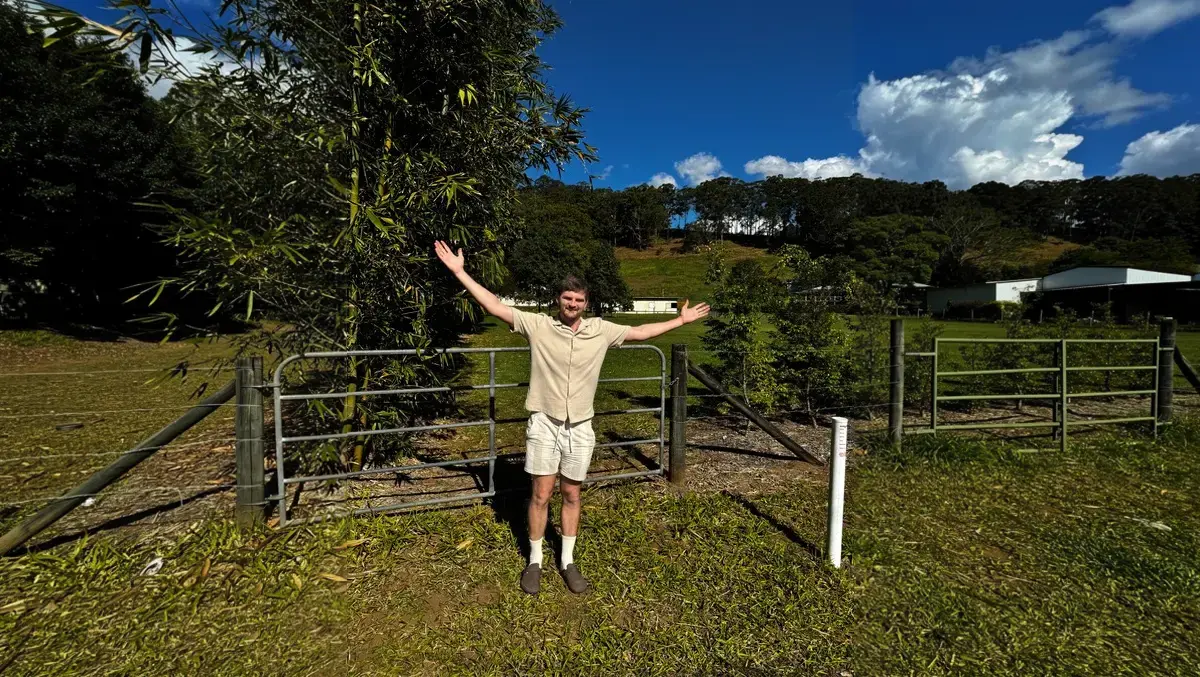
The largely cleared property is about 15 minutes from Maroochydore and has a northern outlook across Petrie Creek, surrounding farmland and rolling hills. Its narrow frontage opens into a deeper parcel with substantial elevation changes, complicating the layout.
Current work includes flood modelling, geotechnical investigation, civil engineering and further refinement of the subdivision design. Stormwater and overland-flow management have been central issues, along with the relationship between road access, future building areas and the site's topography.
Rayner said the challenge was not simply fitting eight lots onto the land, but producing a design that could withstand technical assessment while still delivering practical homesites.
"I've worked through more than 50 different layouts on this property," said Daniel Rayner, Director, Somerset Developments.
"Every time you solve one part of the site, it affects something else. You can improve access and create another earthworks issue. You can change the road alignment and affect drainage. You can create a lot that works geometrically but doesn't produce the quality of building area you actually want to deliver.
"It has forced us to keep coming back to the fundamentals rather than just chasing the maximum theoretical yield."
Technical limits
The project highlights the gap between an early subdivision concept and a design that can progress through detailed engineering and planning review. Rayner said the site's technical realities have repeatedly changed what appeared feasible in preliminary assessments.
"On a simple feasibility, land can look like a spreadsheet - purchase price, number of lots, civil costs and sale values," said Rayner.
"But the land doesn't care about your spreadsheet. The contours, water, soil and access ultimately determine what is possible.
"That is probably the biggest lesson from Rosemount. A concept can look great until the technical work starts. The job is then to keep testing it until the planning, engineering, commercial and end-user outcomes can coexist."
Rosemount was sourced off-market after Rayner wrote directly to the owner. He said the purchase was part of a broader acquisition strategy of writing to owners of sites with subdivision potential rather than relying solely on conventional property searches.
Rayner said about 600 letters were sent to landowners and around 30 owners responded. The strategy surfaced opportunities that would not have appeared through standard market channels, though each site still required detailed due diligence before it could become a project.
Broader pipeline
Rosemount is one of six subdivision projects Somerset Developments has across Moreton Bay and the Sunshine Coast. The company's work ranges from three-lot subdivisions to larger acreage proposals, exposing it to a range of planning, civil and funding issues as site complexity increases.
Rayner's move into development followed a financial setback. In 2022, he invested his entire AUD $150,000 in a Melbourne townhouse development run by another developer and lost the investment when that developer collapsed about a year later.
He then began learning the development process directly. Before taking on his first subdivision, he said he spent more than 100 hours researching potential sites, spoke with 12 town planners, sought tenders from 35 civil contractors, obtained multiple real estate appraisals and ran feasibility calculations on more than 30 properties.
His first completed project involved subdividing a Bellmere property north of Brisbane into four lots. That project gave him direct experience in residential land delivery, including planning, civil design, contractor procurement, construction, plan sealing and title creation.
Rayner said that experience changed how he assesses constrained sites and subdivision design. "The biggest change is that I no longer see a subdivision as lines drawn on a plan," he said.
"Each line has consequences for drainage, access, construction cost, saleability and ultimately for the person who is going to build and live there.
"With Rosemount, the 50-plus designs aren't 50 failures. They're the process of removing bad answers until we arrive at a design that genuinely works."